

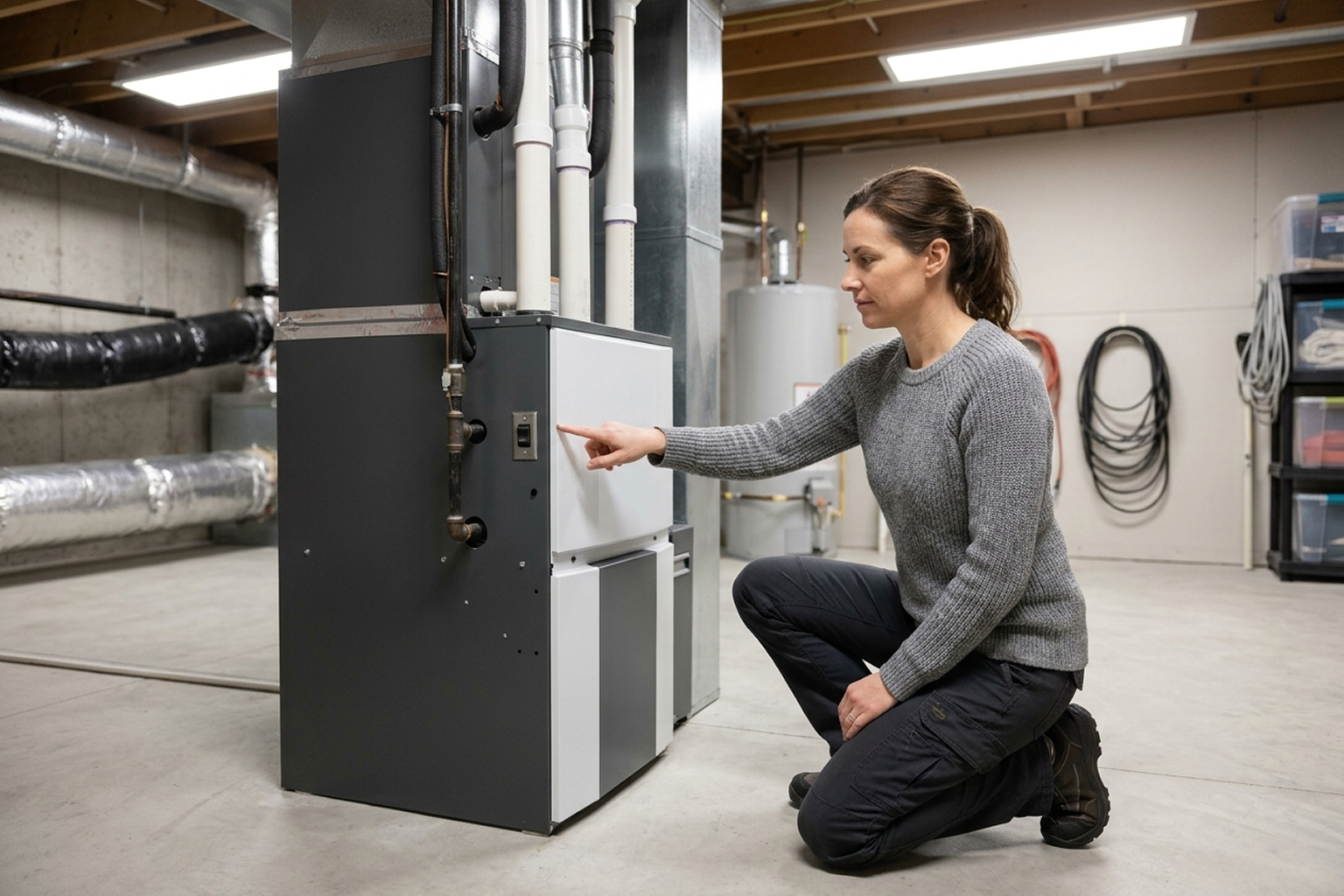
If your furnace is not turning on, check that the thermostat is set to “Heat” above room temperature, the furnace power switch is on, the breaker has not tripped, the filter is clean and the furnace door is fully closed. If all five check out and there is still no heat, the cause is usually inside the furnace (the ignitor, flame sensor, pressure switch or control board), and that is a job for a licensed technician.
It is the first cold night of the year, the thermostat says “Heat”, and nothing happens. Before you call anyone, there are a few checks you can make safely in about ten minutes. They solve a good share of no-heat calls.
This guide covers those checks in order, explains what is going on inside the furnace when they do not work, and tells you when to stop and call.
Safety first: If you smell gas (a rotten egg smell), do not touch the furnace, switches or the thermostat. Leave the house and call your gas utility or 911 from outside. If your carbon monoxide alarm is sounding, leave and call 911.
Step 1: Check the Thermostat Settings and Batteries
Most “furnace not turning on” calls start here.
- Mode: Set it to “Heat”, not “Cool” or “Off”.
- Temperature: Set it at least 5°F above the current room temperature, so the furnace has a reason to start.
- Batteries: If the screen is blank or dim, replace the batteries. Low batteries can keep the screen on but stop the thermostat from signaling the furnace.
- Schedule: On a programmable or smart thermostat, check that a schedule or “away” setting is not holding the temperature down.
If the thermostat clicks when you raise the temperature but nothing else happens, the signal is probably reaching the furnace, and the problem is further along.
Step 2: Make Sure the Furnace Has Power
Even a gas furnace needs electricity to run the controls, ignitor and blower.
- Furnace power switch: Look for a switch that looks like a light switch on the side of the furnace or on a nearby wall or ceiling joist. It should be on. These are easy to flip off by mistake.
- Circuit breaker: In your electrical panel, find the breaker marked “Furnace” or “Heat”. If it is in the middle position, push it fully to “Off” and then back to “On”.
If the breaker trips again, stop. A breaker that trips a second time means an electrical fault. Leave it off and call a technician.
Step 3: Check the Furnace Door
Furnaces have a safety switch behind the front panel. If the panel is loose or not seated after a filter change, the furnace will not start. Make sure the door is pushed fully into place and latched.
Step 4: Check the Air Filter
A clogged filter restricts airflow. The furnace overheats, a safety switch called the high limit shuts the burners off, and after repeated trips some furnaces lock out completely.
Pull the filter out. If it is gray and caked with dust, replace it. Most filters should be changed every one to three months, more often with pets or during heavy use. If you are not sure which filter your system takes, we handle furnace and AC filter replacement as well.
Step 5: Check the Condensate Drain on a High-Efficiency Furnace
High-efficiency furnaces (usually the ones vented with white plastic pipe) produce water. It drains through a small tube to a floor drain or a pump. If the drain line clogs or the pump fails, a float switch shuts the furnace off to prevent a leak.
Look for standing water around the furnace or in the condensate pump. If you see it, call us. Clearing the trap and testing the pump and switch is a quick job for a technician.
Step 6: Confirm the Gas Supply Is On
The manual gas valve on the pipe leading into the furnace should be open, with the handle running parallel to the pipe. If other gas appliances in the house, such as the stove or water heater, are also not working, the issue may be with your gas service. Call your gas utility.
Do not adjust anything on the furnace’s own gas valve or burners.
Step 7: Look at the Status Light, Without Opening the Furnace
Most modern furnaces have a small light on the control board that blinks a code. On many models you can see it through a small window in the lower door. Count the flashes and match them to the chart printed on the inside of the furnace door or in the owner’s manual.
Write the code down. It tells the technician where the startup stopped, even if the furnace starts again on its own later.
Is there a reset button on a furnace? On most furnaces, turning the power switch off for a minute and back on restarts the control board. If the furnace locks out again, do not keep resetting it. Repeated resets can hide a safety problem, and the lockout is there for a reason.
What You Hear and See Tells You Where It Stopped
A gas furnace starts in the same order every time: the thermostat calls for heat, the inducer fan starts, a pressure switch confirms safe venting, the ignitor heats up or sparks, the burners light, the flame sensor proves the flame, and then the blower starts. Where the sequence stops points to the cause.
| What happens when the thermostat calls for heat | Likely cause | Safe to check yourself?
|
|---|---|---|
|
|
|
|
|
|
|
|
|
|
|
|
|
|
|
|
|
|
The Parts Behind Most No-Heat Calls
Furnace Flame Sensor
The flame sensor is a thin metal rod that sits in the burner flame. It sends a tiny electrical signal to the control board to prove the flame is lit. If no flame is proven within a few seconds, the board closes the gas valve. That is a safety feature: it keeps unburned gas from building up.
Over time the rod gets coated with residue, the signal weakens, and the furnace lights and then shuts off within seconds. After a few tries, it locks out.
Many online videos show homeowners removing and cleaning the sensor. It sits inside the burner compartment next to the gas burners and ignitor, so we recommend leaving it to a technician, who can also test the signal and check whether the real cause is a weak flame or a poor ground.
Furnace Ignitor
Most modern furnaces use a hot surface ignitor: a small element that glows bright orange to light the gas. Ignitors are fragile, wear out with use and often crack. A cracked ignitor will not glow, so the burners never light.
Replacing an ignitor means handling a brittle part next to the gas burners and matching the exact replacement, so it is a technician job. It is one of the most common furnace repairs we make.
Furnace Pilot Light Out
Older furnaces use a standing pilot: a small flame that burns all the time and lights the burners. If the pilot goes out, there is no heat.
If your furnace has a pilot and the lighting instructions are printed on the furnace label, you can follow those steps exactly. If you are not comfortable doing it, if the pilot will not stay lit, or if you smell gas at any point, stop and call. A pilot that keeps going out usually points to a worn thermocouple or a dirty pilot assembly.
Pressure Switch and Inducer Motor
Before the burners can light, the inducer fan pushes exhaust out through the vent and a pressure switch confirms the vent is clear. A blocked vent, a cracked hose, a clogged condensate trap or a weak inducer will stop the startup here. In winter, check that snow or leaves are not blocking the vent pipes outside, but leave everything inside the furnace to a technician.
Safe to Do Yourself vs. Call a Technician
| Safe homeowner checks | Leave to a licensed technician
|
|---|---|
|
|
|
|
|
|
|
|
|
|
|
|
When to Call for Furnace Repair Tonight
Call us right away if:
- You have worked through the checks and there is still no heat.
- The breaker trips a second time.
- The furnace locks out again after a reset.
- You see water around a high-efficiency furnace.
- The burners light and shut off over and over.
- The flame looks yellow or lazy instead of crisp blue.
- The temperature in the house is dropping fast on a cold night.
We offer same-day furnace repair from our shop in Pompton Lakes, across Passaic, Morris, Essex and Bergen Counties. Next door in Riverdale, see our Riverdale heating and cooling service.
What to Tell Us When You Call
Having these details ready shortens the visit:
- What the furnace does when the thermostat calls for heat (use the table above).
- The status light code, if you saw one.
- Whether it is a gas or electric furnace, and roughly how old it is.
- When the filter was last changed.
- Whether it stopped suddenly or has been shutting off for a while.
Frequently Asked Questions
Why does my thermostat click but my furnace doesn’t turn on?
The click means the thermostat is sending the call for heat. If the furnace does not respond, check the power switch, the breaker and the furnace door. If those are fine, the fault is in the furnace’s startup sequence, such as the inducer, pressure switch, ignitor or control board.
What fails first on a furnace?
The parts that wear out most often are the ignitor and the flame sensor, followed by capacitors, inducer motors and pressure switches. A clogged air filter is the most common cause of shutdowns that are not a failed part at all.
Why is my furnace short cycling?
Short cycling, where the furnace starts and stops every few minutes, is usually caused by a clogged filter, an overheating limit switch, a dirty flame sensor or a thermostat in the wrong spot. Replace the filter first. If it continues, call a technician, because short cycling wears out parts quickly.
Can I clean the flame sensor myself?
It sits inside the burner compartment next to the gas burners and ignitor, so we recommend a technician do it. They can also test the flame signal and find out why the sensor got dirty in the first place.
How do I keep my furnace from failing next winter?
Change the filter every one to three months and book a yearly tune-up before the heating season. A tune-up cleans the flame sensor, checks the ignitor and tests the safety controls, which covers most of the causes in this guide.
Is It Time to Repair or Replace?
If your furnace is under 15 years old, a no-start is usually a single failed part and worth repairing. If it is older and this is the latest in a string of repairs, it is worth pricing a furnace replacement before you spend more.
Want a number first? Our free HVAC cost calculator shows you a price range for a new system in about 30 seconds, before anyone comes out.